The city’s shared mind

A city, governed together.

Konsesa brings residents’ voices together, makes the municipality’s work visible and moves decisions onto common ground. Request management, participation and decision support on one platform.

Konsesa listens, summarises and prepares. Decisions are made together.
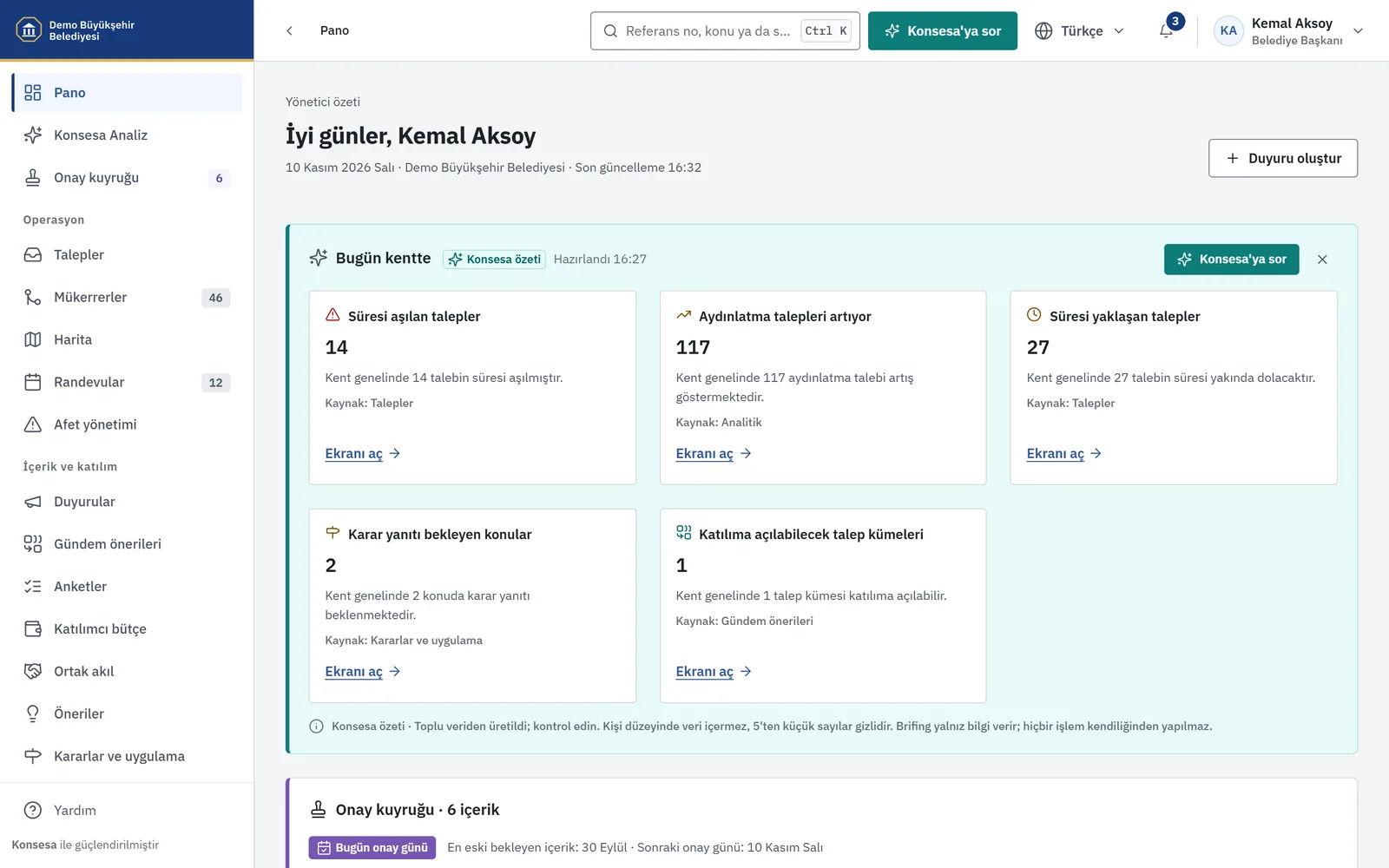
Mayor’s dashboard: today-in-the-city briefing, overdue and upcoming requests, topics awaiting a decision Resident’s home screen on a phone: Ask Konsesa box and Report button

Product screens are shown in the Turkish interface.

Where cities stand today

The problem isn’t silence. It’s disconnection.

Residents speak up, but their voices never add up. The municipality works hard, but the work goes unseen.

  • 01

    Scattered channels

    Phone, central complaint portals, social media, separate apps. Residents have to work out which department to contact.

  • 02

    Manual processes

    Requests are sorted by hand and sent to the wrong unit; dozens of duplicate records pile up for the same issue.

  • 03

    Invisible service

    Even when the job gets done, residents never hear about it. Work that is done looks like work that isn’t.

  • 04

    The silent majority

    Decisions are shaped by a few loud voices. People who want to weigh in have no easy way to do so.

How it works

Two loops, one platform.

Service loop · from request to verified resolution

  1. A resident describes it
  2. Konsesa suggests the unit
  3. The crew fixes it on site
  4. Closed with a photo
  5. The resident sees the result

Participation loop · from idea to shared decision

  1. A resident proposes
  2. Konsesa summarises views
  3. Common ground is voted on
  4. The municipality responds
  5. Delivery is tracked

Both loops share the same identity, the same data and the same records. Every Konsesa step is a suggestion that an authorised person approves.

Modules

Everything a municipality needs, on one platform.

Turn modules on as you need them; all of them run on the same identity and data.

Service

  • Request management

    From report to verified closure

  • Field app

    Tasks, map, photos

  • Appointments

    Online booking, reminders

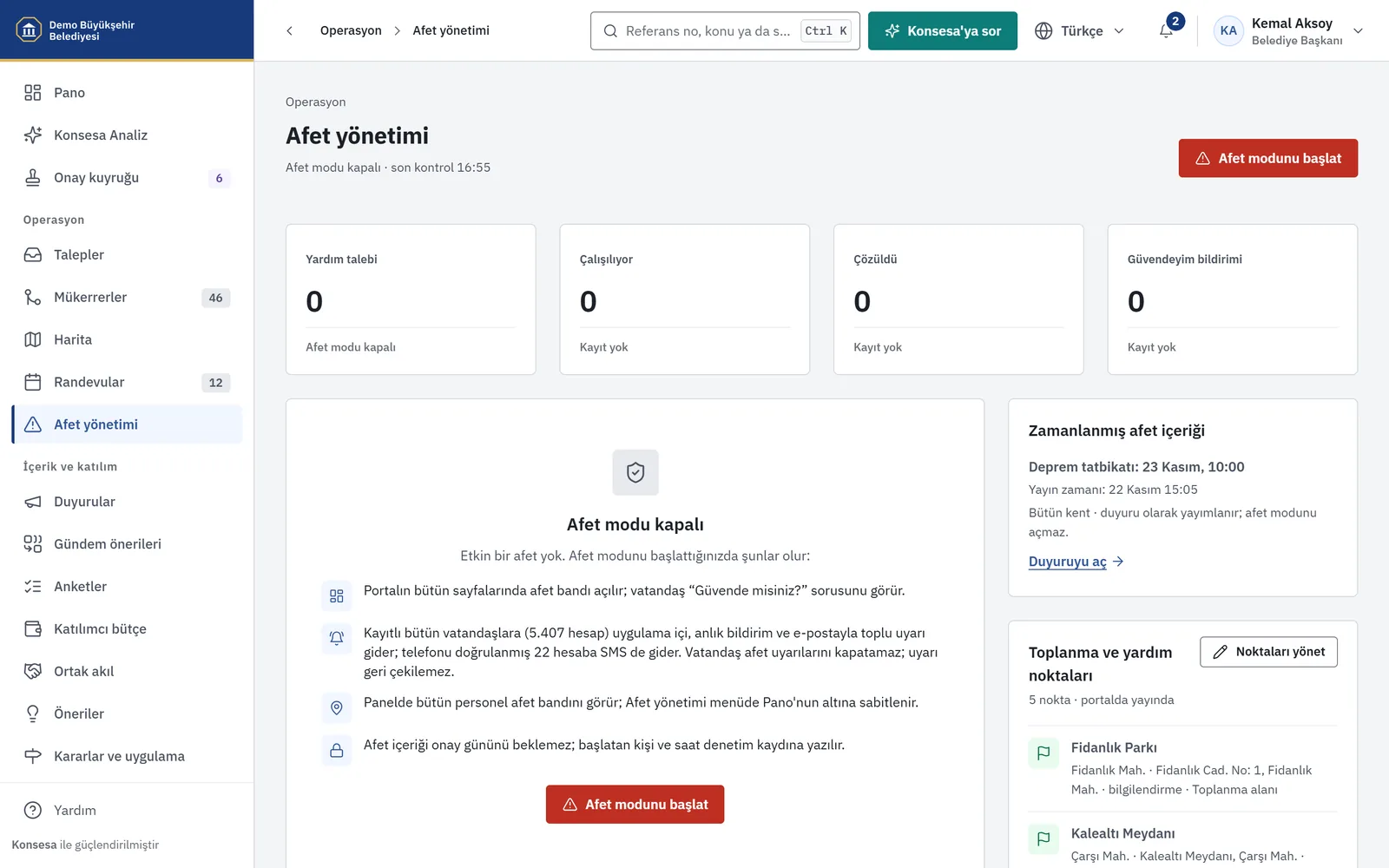
  • Emergency management

    One-click mass alerts

Participation

  • Common Ground

    Deliberation that finds agreement

  • Surveys

    Conditional questions, summaries

  • Participatory budget

    Identity-verified project voting

  • City proposals

    Support threshold, formal reply

Communication and management

  • Smart announcements

    Right neighbourhood, right language

  • Konsesa Insights

    Decision support in plain language

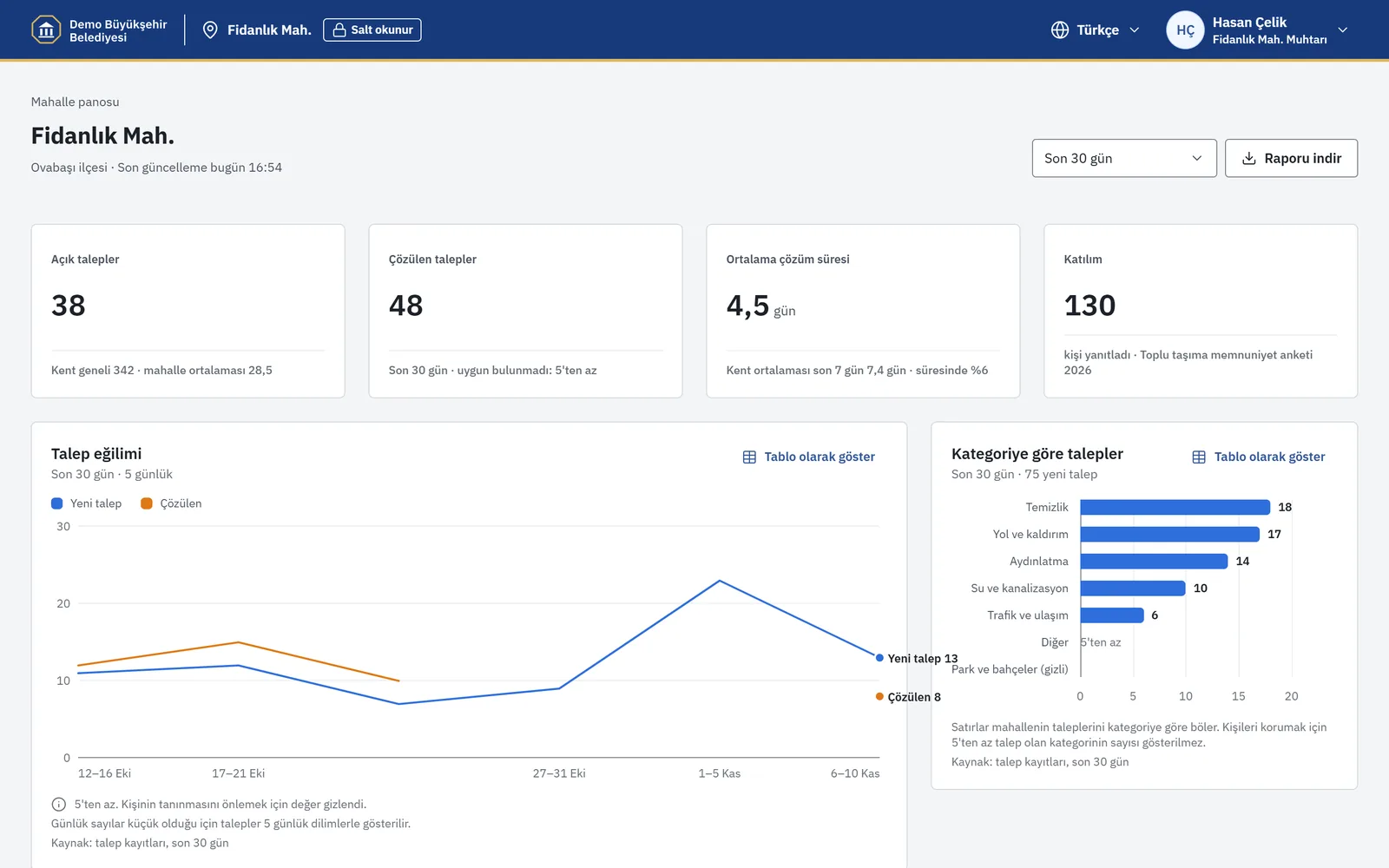
  • Neighbourhood dashboard

    Local data for the mukhtar

  • Transparency

    Decisions and delivery map

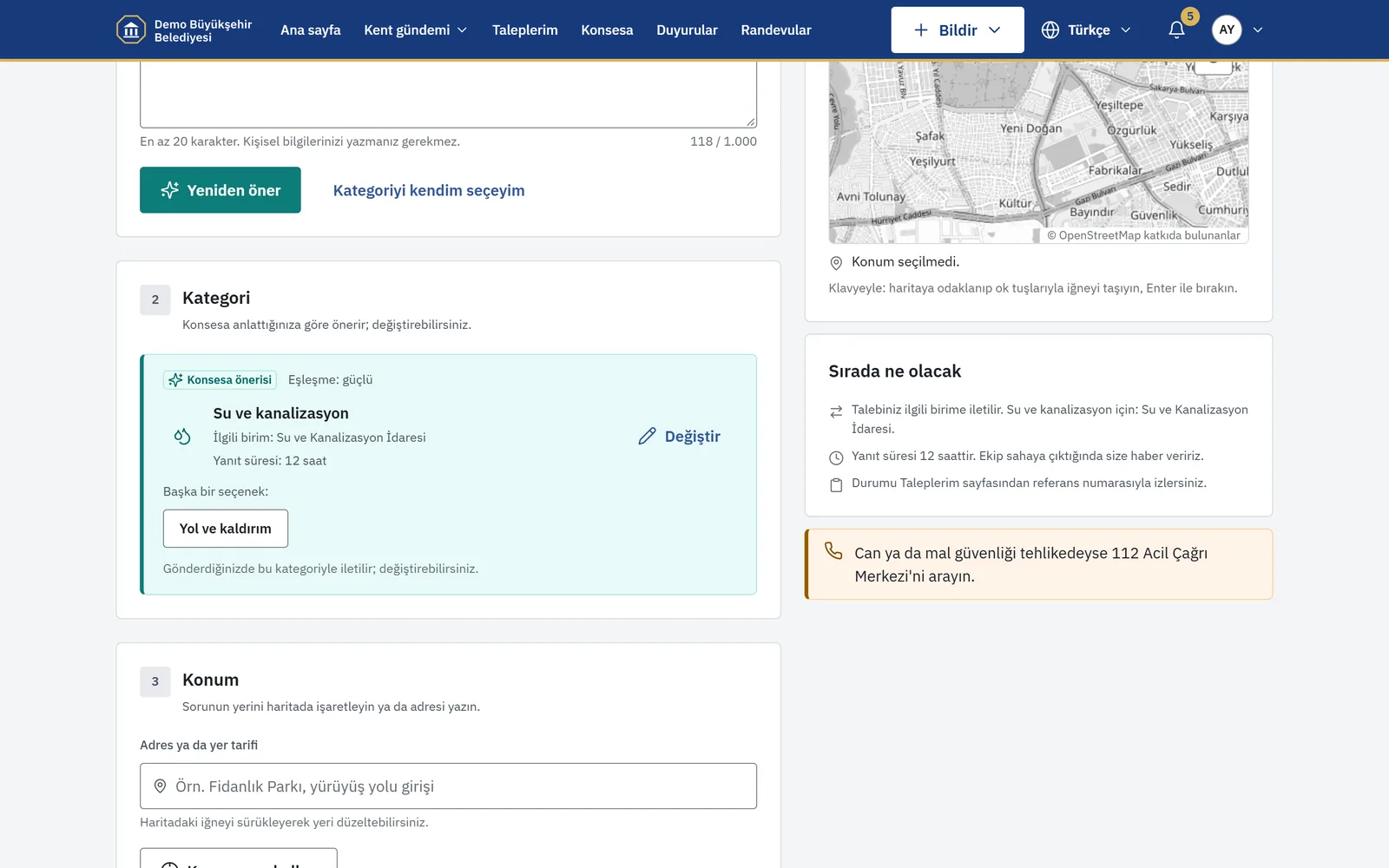
Residents · report by describing

No forms. Just tell us.

“The pavement on Stadium Road has caved in and water is gushing out underneath.”
  • Konsesa suggests the category and the unit; the resident confirms.
  • The response time is visible from the start.
  • Via the portal, the phone and WhatsApp.
Report a problem screen: the resident’s own words and Konsesa’s suggestion with category, responsible unit and a 12-hour response time

Residents · transparent tracking

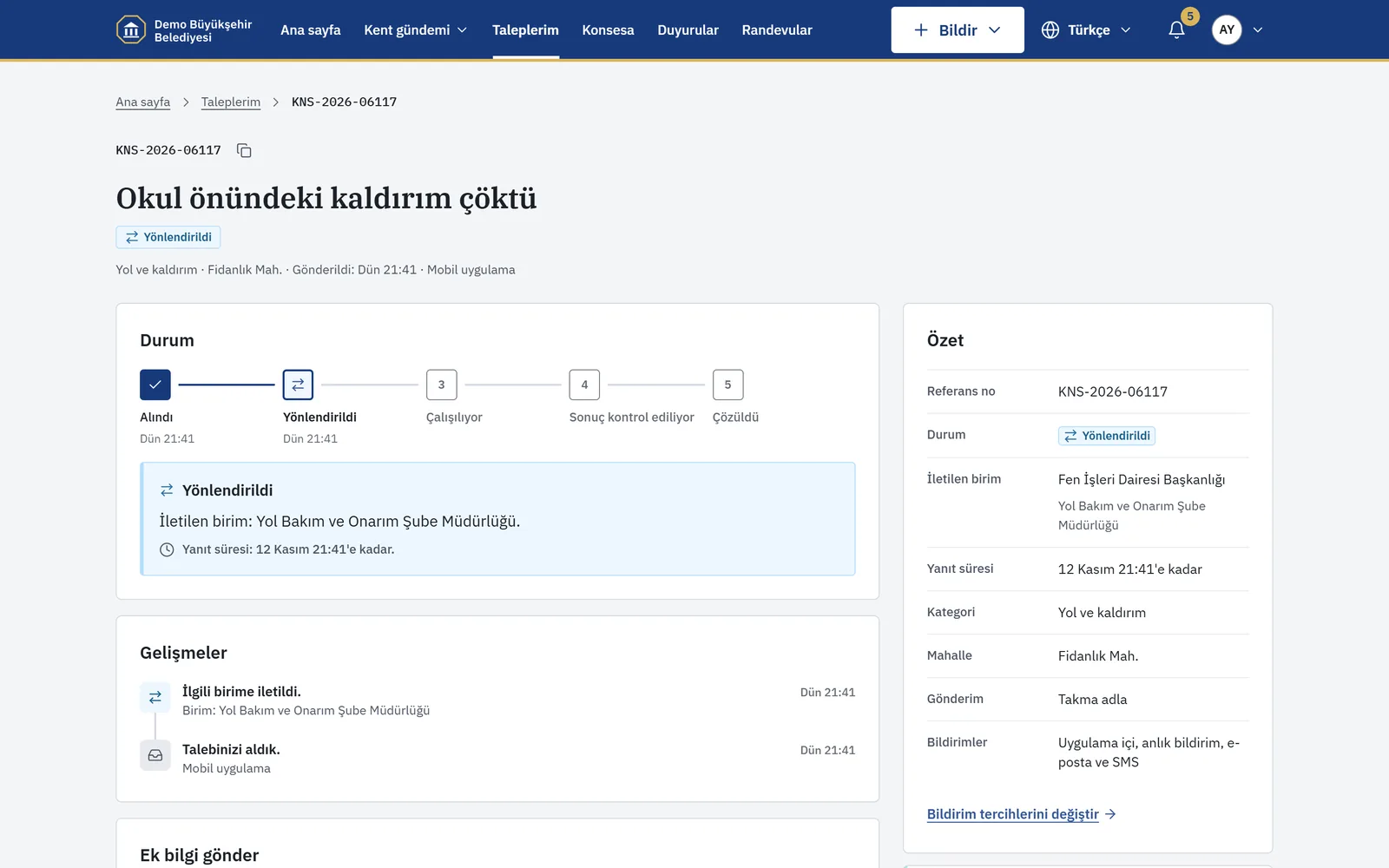
Every step visible. Every closure verified.

  • Received, routed, in progress, resolved: which unit, and when.
  • A notification at every change: in the app, by email or by SMS.
  • A proof photo from the field crew is required to close a request.
Request detail: status steps, responsible unit, response time and updates

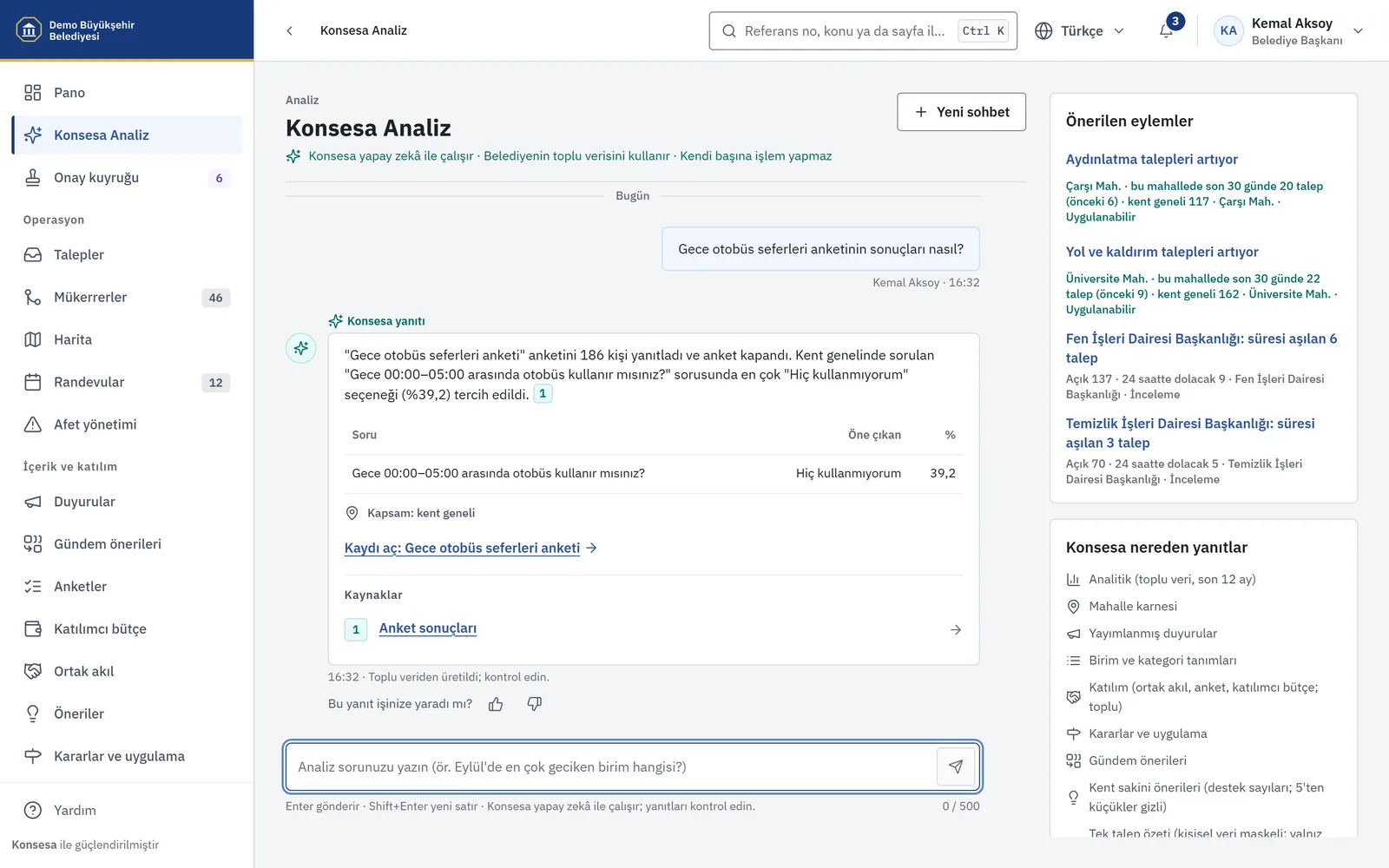
Management · Konsesa Insights

Leaders ask Konsesa, too.

  • Plain-language questions about surveys, topics, requests, announcements, proposals and emergencies.
  • Every answer shows its source.
  • Only the municipality’s aggregated data, according to each person’s role.
Konsesa Insights: a sourced answer to the mayor’s question about the night bus survey

Scenarios

Konsesa on a real day.

Five concrete cases, step by step. Screens are from the product itself, in its Turkish interface; the data belongs to a demo municipality.

From complaint to shared decision

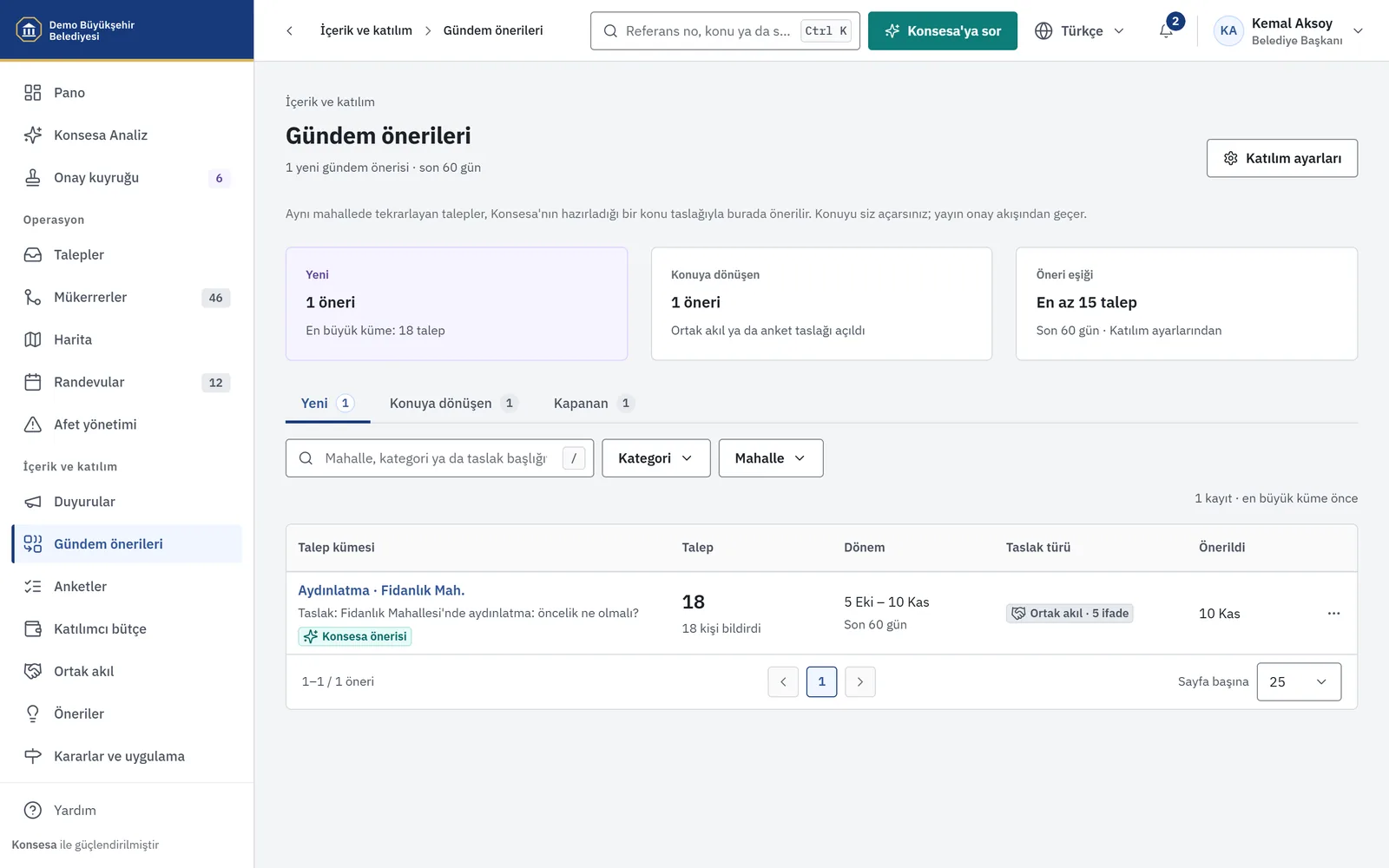
  1. 18 street-lighting requests arrive from one neighbourhood.
  2. Konsesa groups them and drafts a discussion topic.
  3. The municipality opens the topic and invites everyone who reported.
  4. Common ground emerges: “Broken lamps should be fixed within a week.”
  5. The municipality publishes its decision; delivery is tracked on the map.
Agenda suggestions: 18 street-lighting requests and a Common Ground draft prepared by Konsesa

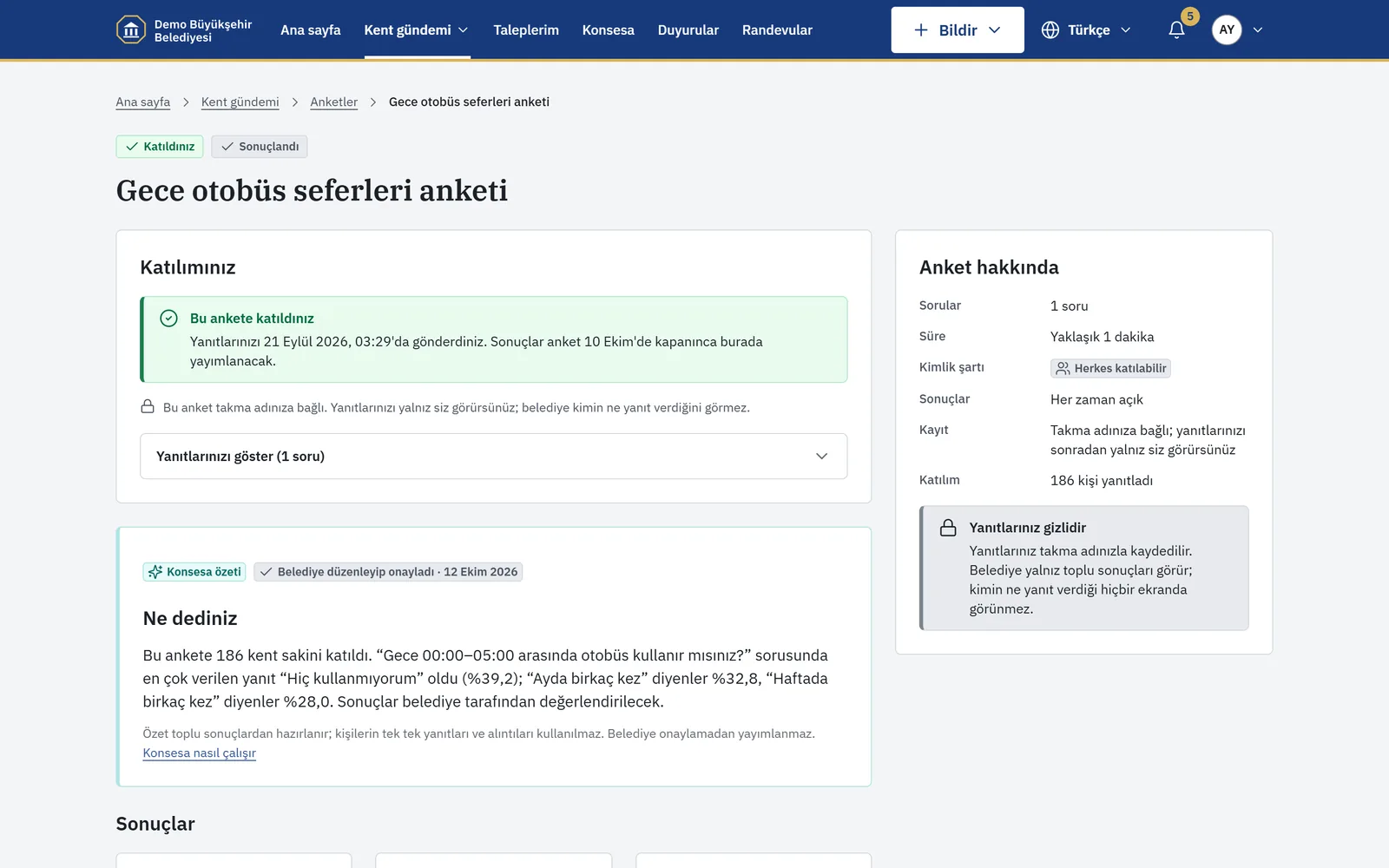
Do we need night buses?

  1. The municipality asks: “Do you take the bus between midnight and 5 a.m.?”
  2. 186 residents answer under a pseudonym, in confidence.
  3. Konsesa summarises: 39% never, 33% a few times a month, 28% a few times a week.
  4. The municipality approves; participants see a “What you said” summary.
  5. When the decision is published, everyone who took part is notified.
The survey page as residents see it, with the What you said summary approved by the municipality

Residents set the priorities

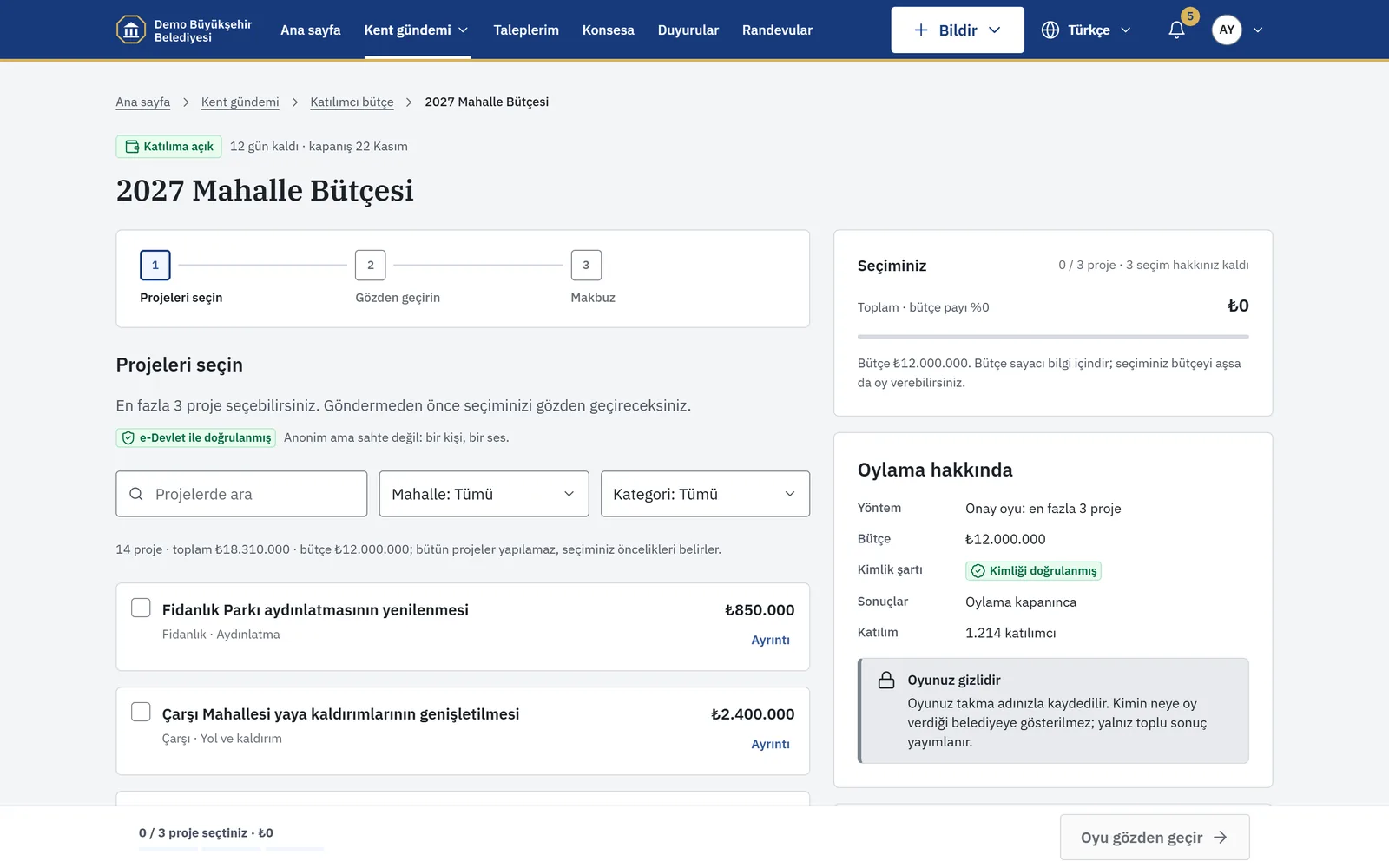
  1. The municipality opens its 2027 neighbourhood budget: ₺12 million, 14 projects.
  2. The projects add up to ₺18.3 million, so not all of them can be built.
  3. Each resident picks up to 3 projects; identity-verified, one person, one vote.
  4. 1,214 people vote; nobody can see who voted for what.
  5. Winning projects are published and their construction is tracked on the map.
2027 neighbourhood budget voting screen: project list, costs and a ₺12 million budget

Should the old bazaar go car-free?

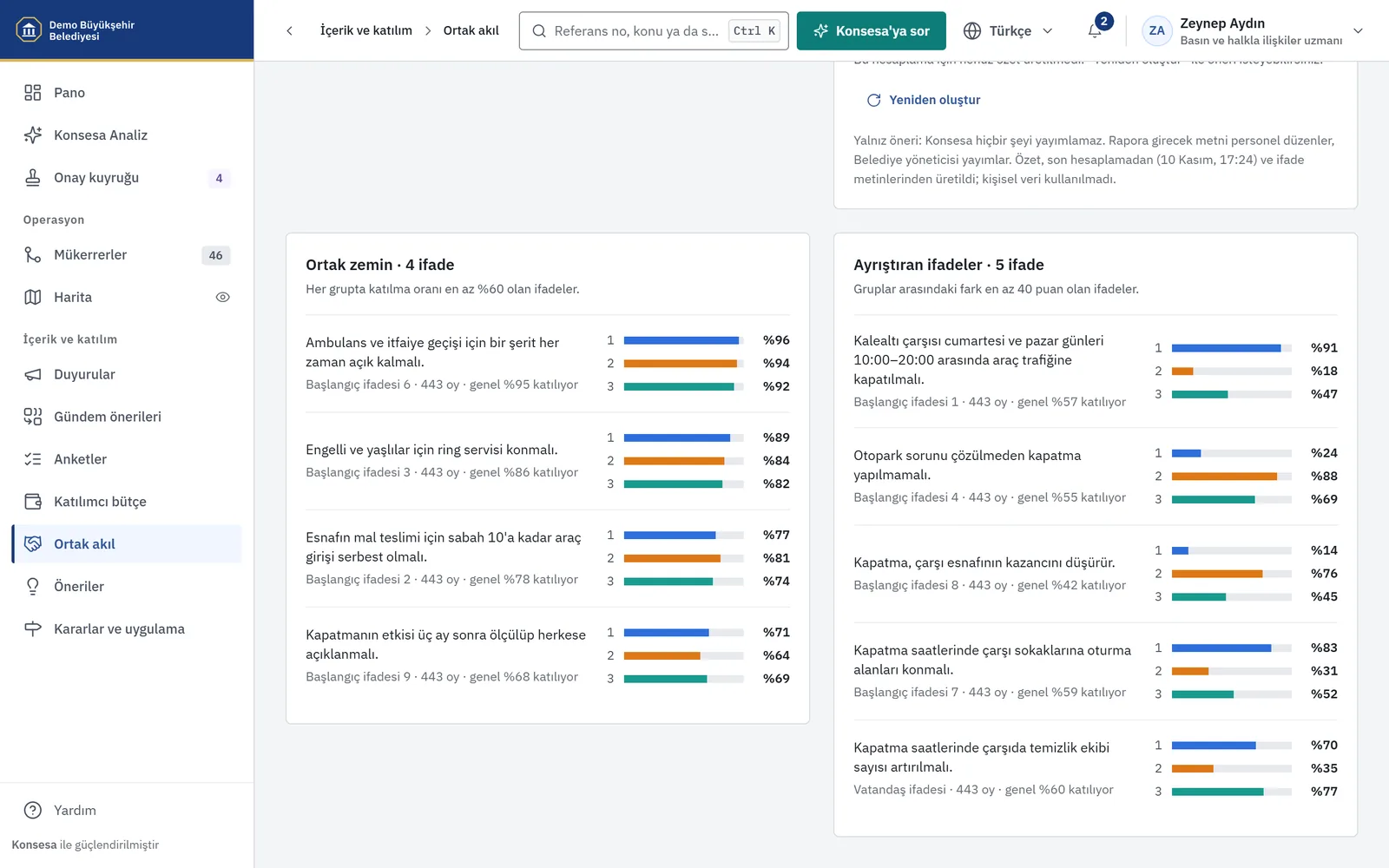
  1. 662 people vote on 28 statements; Konsesa groups like-minded people into three clusters.
  2. The main proposal divides them: 91%, 18% and 47% in favour.
  3. Yet all three groups agree on a lane always open for ambulances and fire engines (96% · 94% · 92%).
  4. And on a shuttle for disabled and elderly people (89% · 84% · 82%) and deliveries until 10 a.m. (77% · 81% · 74%).
  5. The municipality builds its decision on that common ground and publishes its reasoning.
Common Ground: statements with common ground and divisive statements, with agreement rates for three opinion groups

The right neighbourhood, the right language

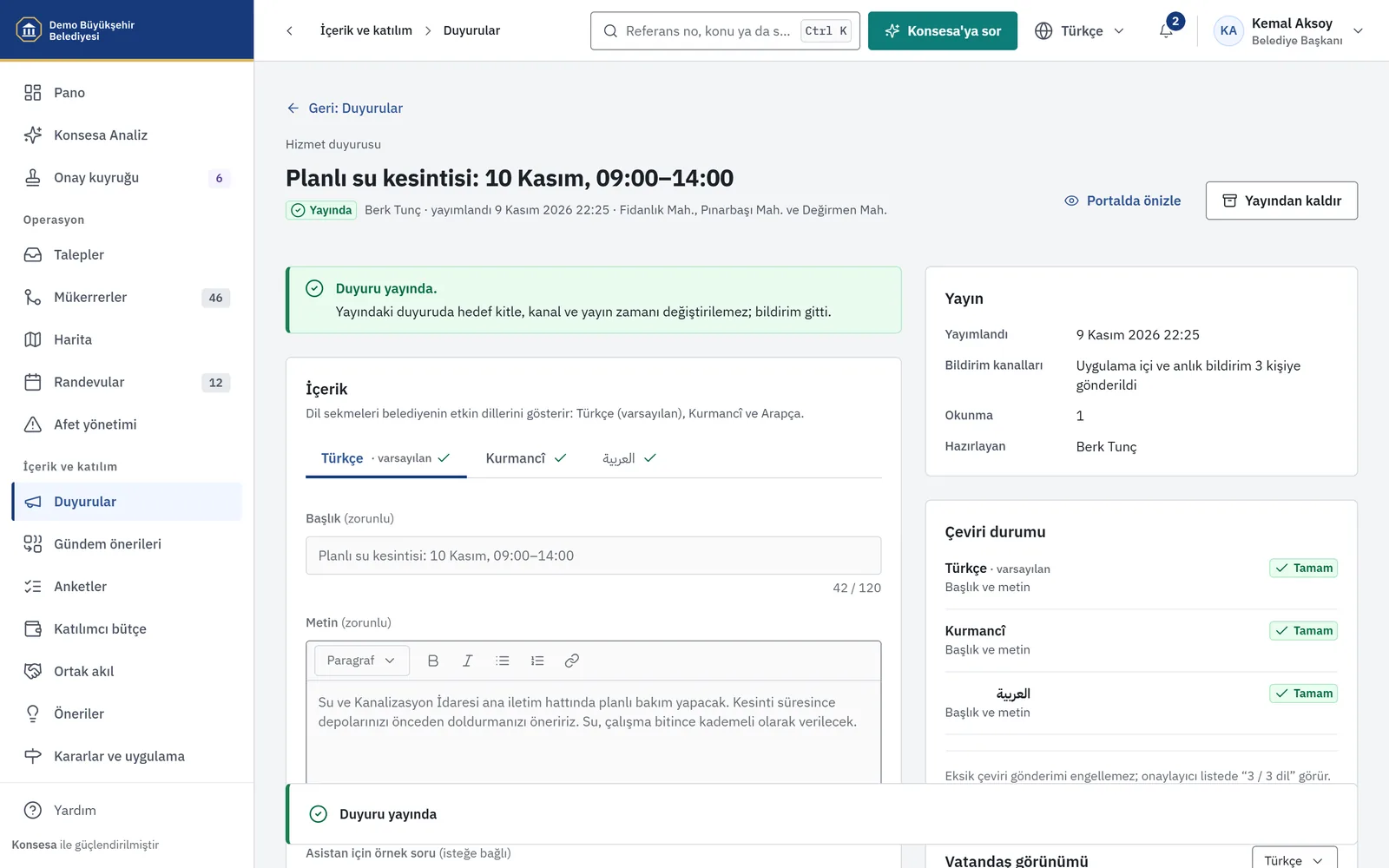
  1. The water utility prepares a planned-maintenance notice.
  2. Konsesa drafts the text; an authorised person approves it.
  3. The notice goes only to the three affected neighbourhoods.
  4. Each resident receives it in their own language.
  5. The municipality sees how many people it reached and who read it.
Announcement detail: planned water outage targeted at three neighbourhoods, translation status and reads

Hard days and neighbourhoods

Konsesa

Konsesa listens, summarises and prepares. Decisions are made together.
  • Listens

    Understands what residents write in their own words and suggests the category and unit.

  • Summarises

    Condenses hundreds of opinions, survey answers and requests, always citing the source.

  • Prepares

    Drafts replies, announcements and discussion topics; an authorised person always sends them.

Konsesa runs on AI and never sends or publishes anything on its own.

Access
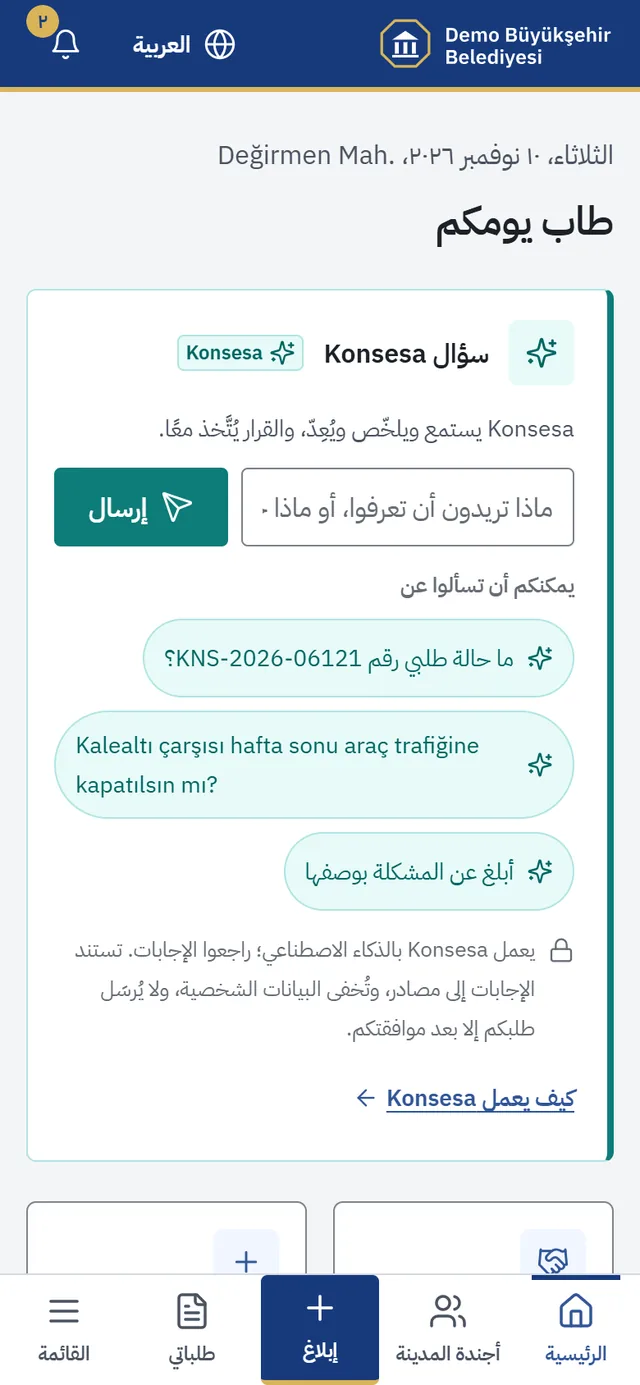
For every resident, on every device.

  • Works on any phone; no app to download.
  • Multilingual, with right-to-left Arabic.
  • Residents can also write via WhatsApp.
  • Usable with a keyboard and a screen reader.
  • Emergency mode and appointments on the same platform.
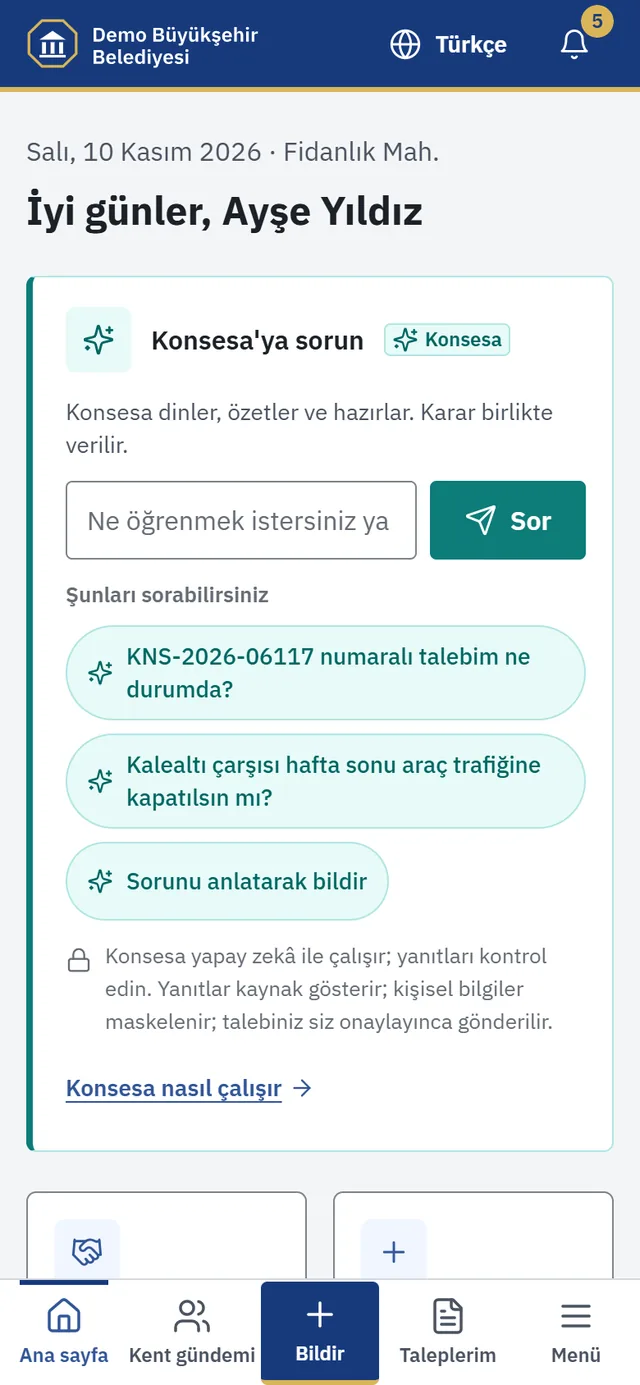
Resident’s home screen on a phone, in TurkishThe same screen in Arabic, right-to-left layout

Trust

Data protection is part of the design.

  • Identity stays protected

    Identity data is kept separately; participation only shows a pseudonym.

  • Human approval

    Konsesa never sends anything on its own; an authorised person approves every draft.

  • Personal data is masked

    Personal data is hidden before it reaches the model; results from fewer than 5 people are never shown.

  • Open and auditable

    Versioned consent records; a public “How Konsesa works” page.

Installed on the municipality’s own servers or in a data centre in Türkiye. The AI model is the municipality’s choice: on-premises or cloud. Compliant with Türkiye’s data protection law (KVKK).

Integrations

Works with the systems a municipality already has.

  • Identity

    Sign-in with e-Devlet, verification with MERNİS

  • Address

    Address validation with UAVT

  • WhatsApp

    A resident writes, a request is created

  • Notifications

    SMS, email and push notifications

  • Maps

    Neighbourhood boundaries, location, delivery map

  • Other systems

    Records management and e-municipality systems via API, adapted to each municipality

The connectors are ready; they go live with the pilot municipality’s credentials and existing systems.

Pilot

From pilot to city-wide, step by step.

  1. Months 0–3

    Pilot

    One district or department. Reporting, transparent tracking and verified closure; staff training.

  2. Months 3–9

    Expansion

    All departments. Common Ground, surveys, participatory budget, city proposals and Konsesa Insights.

  3. Month 9 onwards

    City-wide

    Open city agenda, delivery map, mukhtar dashboard and an annual participation report.

What we measure together in the pilot

  • Resolution time
  • Right unit first time
  • Duplicate rate
  • Resident satisfaction
  • Number of participants

Why Konsesa

The winner: the city.

The mayor’s office

  • Service that is visible and verified.
  • Decisions grounded in data and public opinion.
  • A pioneering identity in participatory city government.

Municipal teams

  • The right unit, first time.
  • Fewer duplicates, less manual work.
  • Drafts ready; the decision stays with the team.

Residents

  • Describe the problem in their own words.
  • See the result, with proof.
  • Have a say in decisions.

Request a demo

Let’s start with a pilot.

Fill in the form for a live demo tailored to your municipality and a pilot conversation. We’ll get back to you within two working days.

  • Live product demo (45 minutes)
  • A pilot scope that fits your municipality
  • Installation and data security questions

Or write to us directly: info@vinterna.com